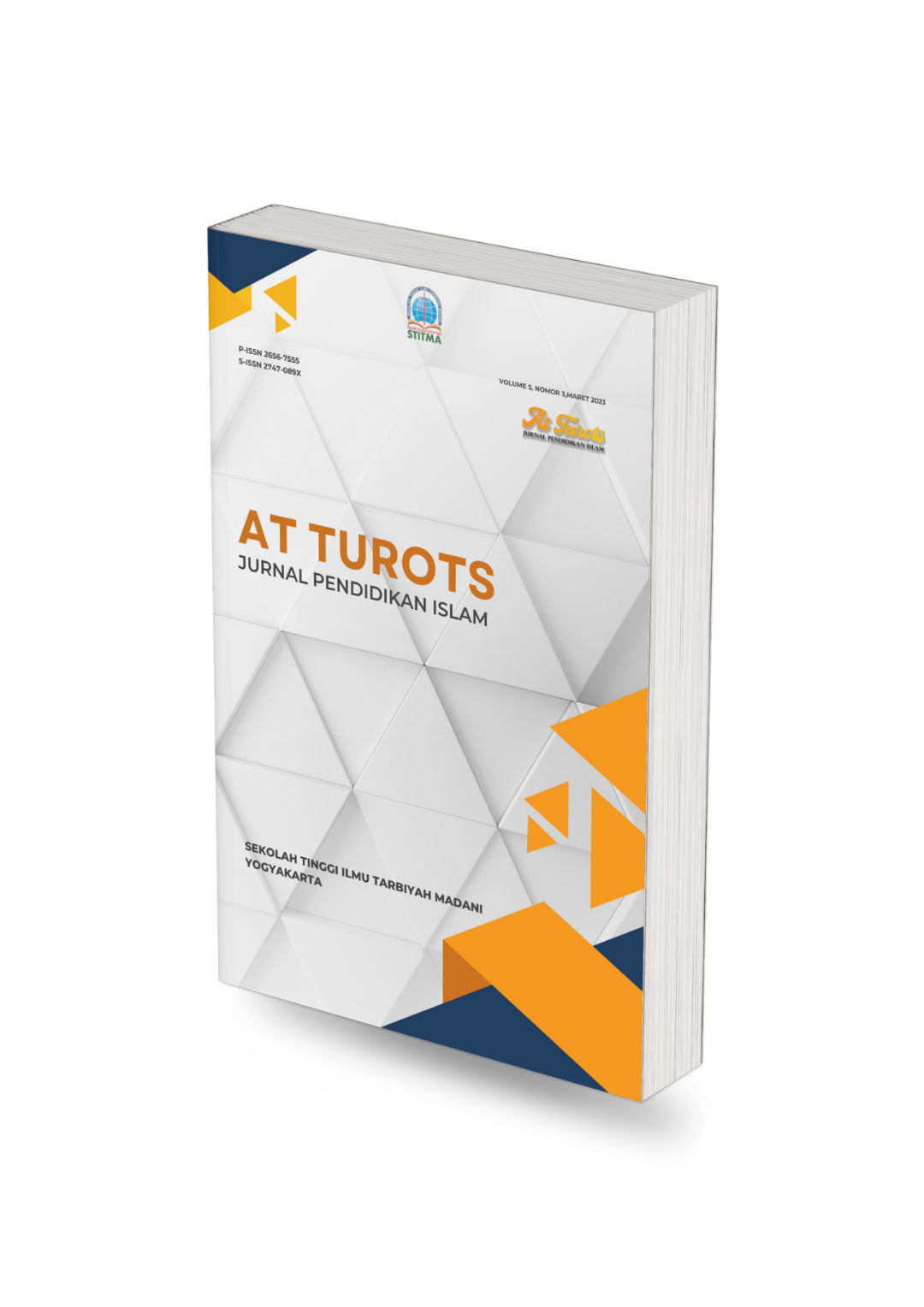
The Use of Test and Non-Test Techniques in the Assessment of Arabic Term Comprehension in PAI Learning at SDIT Salsabila Al Muthi'in
DOI:
https://doi.org/10.51468/jpi.v8i2.1718Keywords:
test and non-test techniques, understanding of Arabic terms, learning assessmentAbstract
The assessment of Islamic Religious Education (PAI) learning in elementary schools requires evidence that can distinguish the understanding of the meaning of Arabic terms from memorization and learning engagement. This study aims to describe the planning, implementation, and utilization of assessment results through test and non-test techniques at SDIT Salsabila Al Muthi'in. The research uses a qualitative approach with a case study design in PAI learning in grades III and VI. The main informants are PAI teachers who are selected purposively. Data were collected through learning observation, semi-structured interviews, and document review, then analyzed thematically. The validity of the data was checked through the comparison of evidence sources and interpretation confirmation to the informant. The results showed that assessment planning refers to the material, learning targets, and grade level, but the grid was not available to be examined during the study. The implementation of the assessment included thematic written questions, daily tests, informal oral questions, and observation of students' activities, attitudes, and responses. Non-test observations did not use structured instruments so that evidence of learning engagement could not be equated with evidence of understanding of meaning. The results of the assessment were used to identify students who had not achieved the target and provide additional guidance. The obstacles found included time constraints and differences in the level of understanding of students. This study showed the connection between the assessment and mentoring processes, but could not be assured of its effectiveness on the understanding of Arabic terms because indicators, specific errors, and developments after follow-up have not been documented. The development of assessments requires explicit indicators of meaning, structured instruments, and reassessment to examine the success of mentoring.
References
Abdurahman, A., & Erihadiana, M. (2024). Comprehensive assessment: Balancing test and non-test methods in Islamic education evaluation. Jurnal Inovasi Pendidikan Agama Islam (JIPAI), 4(2), 95–108. https://doi.org/10.15575/jipai.v4i2.40752
Andrade, H. L. (2019). A critical review of research on student self-assessment. Frontiers in Education, 4, 87. https://doi.org/10.3389/feduc.2019.00087
Azis, A., Abou-Samra, R., & Aprilianto, A. (2022). Online assessment of Islamic religious education learning. Tafkir: Interdisciplinary Journal of Islamic Education, 3(1), 60–76. https://doi.org/10.31538/tijie.v3i1.114
Bennett, R. E. (2011). Formative assessment: a critical review. Assessment in Education: Principles, Policy & Practice, 18(1), 5–25. https://doi.org/10.1080/0969594x.2010.513678
Biggs, J. (1996). Enhancing teaching through constructive alignment. Higher Education, 32, 347–364. https://doi.org/10.1007/BF00138871
Black, P., & Wiliam, D. (1998). Assessment and classroom learning. Assessment in Education: Principles, Policy & Practice, 5(1), 7–74. https://doi.org/10.1080/0969595980050102
Black, P., & Wiliam, D. (2009). Developing the theory of formative assessment. Educational Assessment, Evaluation and Accountability, 21(1), 5–31. https://doi.org/10.1007/s11092-008-9068-5
Braun, V., & Clarke, V. (2006). Using thematic analysis in psychology. Qualitative Research in Psychology, 3(2), 77–101. https://doi.org/10.1191/1478088706qp063oa
Creswell, J. W., & Poth, C. N. (2018). Qualitative inquiry and research design: Choosing among five approaches (4th ed.). SAGE Publications.
Hattie, J., & Timperley, H. (2007). The power of feedback. Review of Educational Research, 77(1), 81–112. https://doi.org/10.3102/003465430298487
Henriksen, B. (1999). Three dimensions of vocabulary development. Studies in Second Language Acquisition, 21(2), 303–317. https://doi.org/10.1017/s0272263199002089
Heritage, M., Kim, J., Vendlinski, T., & Herman, J. (2009). From evidence to action: A seamless process in formative assessment? Educational Measurement: Issues and Practice, 28(3), 24–31. https://doi.org/10.1111/j.1745-3992.2009.00151.x
Ijarmana, F., & Putra, E. D. (2021). Analisis kesulitan guru dalam menerapkan penilaian autentik di sekolah dasar negeri. NATURALISTIC: Jurnal Kajian Penelitian Pendidikan Dan Pembelajaran, 6(1), 1050–1059. https://doi.org/10.35568/naturalistic.v6i1.1366
Mohamad, N., Nor Amin Samsun Baharun, M., Bin Wan Abd Rahman, A., & Mohd Ramli, Z. (2021). Receptive and productive Arabic academic vocabulary mastery: A study of students in Malaysian public universities. International Journal of Asian Social Science, 11(3), 154–167. https://doi.org/10.18488/journal.1.2021.113.154.167
Mukmin, M., & Nuraini, N. (2024). Integrasi penilaian tes dan non-tes dalam Pendidikan Agama Islam: Menuju evaluasi holistik untuk pembelajaran berkelanjutan. Journal of Instructional and Development Researches, 4(5), 370–379. https://doi.org/10.53621/jider.v4i5.384
Nafiati, D. A. (2021). Revisi taksonomi Bloom: Kognitif, afektif, dan psikomotorik. Humanika, 21(2), 151–172. https://doi.org/10.21831/hum.v21i2.29252
Nation, I. S. P. (2013a). Knowing a word. In Learning vocabulary in another language (2nd ed., pp. 44–91). Cambridge University Press. https://doi.org/10.1017/CBO9781139858656.004
Nation, I. S. P. (2013b). Learning vocabulary in another language (2nd ed.). Cambridge University Press.
Nation, I. S. P. (2022). Learning vocabulary in another language (3rd ed.). Cambridge University Press. https://doi.org/10.1017/9781009093873
Nurlitasari, A., & Hamami, T. (2023). Assessment as, for, of learning pembelajaran pendidikan agama Islam tingkat menengah atas. Humanika, 23(2), 225–234. https://doi.org/10.21831/hum.v23i2.61406
Panadero, E., & Jonsson, A. (2013). The use of scoring rubrics for formative assessment purposes revisited: A review. Educational Research Review, 9, 129–144. https://doi.org/10.1016/j.edurev.2013.01.002
Puspitasari, I., Suryani, A. I., & Arifin, S. (2023). Pengembangan alat penilaian mata pelajaran Pendidikan Agama Islam dengan menggunakan Quizizz di sekolah menengah pertama. Jurnal Basicedu, 7(1), 816–827. https://doi.org/10.31004/basicedu.v7i1.4678
Putri, H., Susiani, D., Wandani, N. S., & Putri, F. A. (2022). Instrumen penilaian hasil pembelajaran kognitif pada tes uraian dan tes objektif. Jurnal Papeda: Jurnal Publikasi Pendidikan Dasar, 4(2), 139–148. https://doi.org/10.36232/jurnalpendidikandasar.v4i2.2649
Read, J. (2000). Assessing vocabulary. Cambridge University Press. https://doi.org/10.1017/CBO9780511732942
Sadler, D. R. (1989). Formative assessment and the design of instructional systems. Instructional Science, 18(2), 119–144. https://doi.org/10.1007/bf00117714
Sawaluddin, S., & Muhammad, S. (2020). Langkah-langkah dan teknik evaluasi hasil belajar Pendidikan Agama Islam. Jurnal PTK Dan Pendidikan, 6(1). https://doi.org/10.18592/ptk.v6i1.3793
Schildkamp, K., van der Kleij, F. M., Heitink, M. C., Kippers, W. B., & Veldkamp, B. P. (2020). Formative assessment: A systematic review of critical teacher prerequisites for classroom practice. International Journal of Educational Research, 103, 101602. https://doi.org/10.1016/j.ijer.2020.101602
Schmitt, N. (2014). Size and depth of vocabulary knowledge: What the research shows. Language Learning, 64(4), 913–951. https://doi.org/10.1111/lang.12077
Schmitt, N., Schmitt, D., & Clapham, C. (2001). Developing and exploring the behaviour of two new versions of the Vocabulary Levels Test. Language Testing, 18(1), 55–88. https://doi.org/10.1177/026553220101800103
Shute, V. J. (2008). Focus on formative feedback. Review of Educational Research, 78(1), 153–189. https://doi.org/10.3102/0034654307313795
Subehi, R., & Sriyanto, S. (2021). Implementasi assessment of, for, dan as learning dalam pembelajaran daring PAI di SMPN 8 Purwokerto. Alhamra Jurnal Studi Islam, 2(2), 111–122. https://doi.org/10.30595/ajsi.v2i2.10632
Webb, S., Sasao, Y., & Ballance, O. (2017). The updated Vocabulary Levels Test: Developing and validating two new forms of the VLT. ITL - International Journal of Applied Linguistics, 168(1), 33–69. https://doi.org/10.1075/itl.168.1.02web
Widiyarto, A., & Inayati, N. L. (2023). Penerapan evaluasi pembelajaran tes dan non-tes Pendidikan Agama Islam di sekolah menengah kejuruan. Munaddhomah: Jurnal Manajemen Pendidikan Islam, 4(2), 307–316. https://doi.org/10.31538/munaddhomah.v4i2.439
Wisniewski, B., Zierer, K., & Hattie, J. (2020). The power of feedback revisited: A meta-analysis of educational feedback research. Frontiers in Psychology, 10, 3087. https://doi.org/10.3389/fpsyg.2019.03087
Yen, C. C., Lee, C. Y., Chen, G. D., Wang, J. H., & ... (2020). A Digital Reality Learning Environment with Instant Assessment on Learning with Body and Visual Interaction. … on Advanced Learning …. https://ieeexplore.ieee.org/abstract/document/9155883/